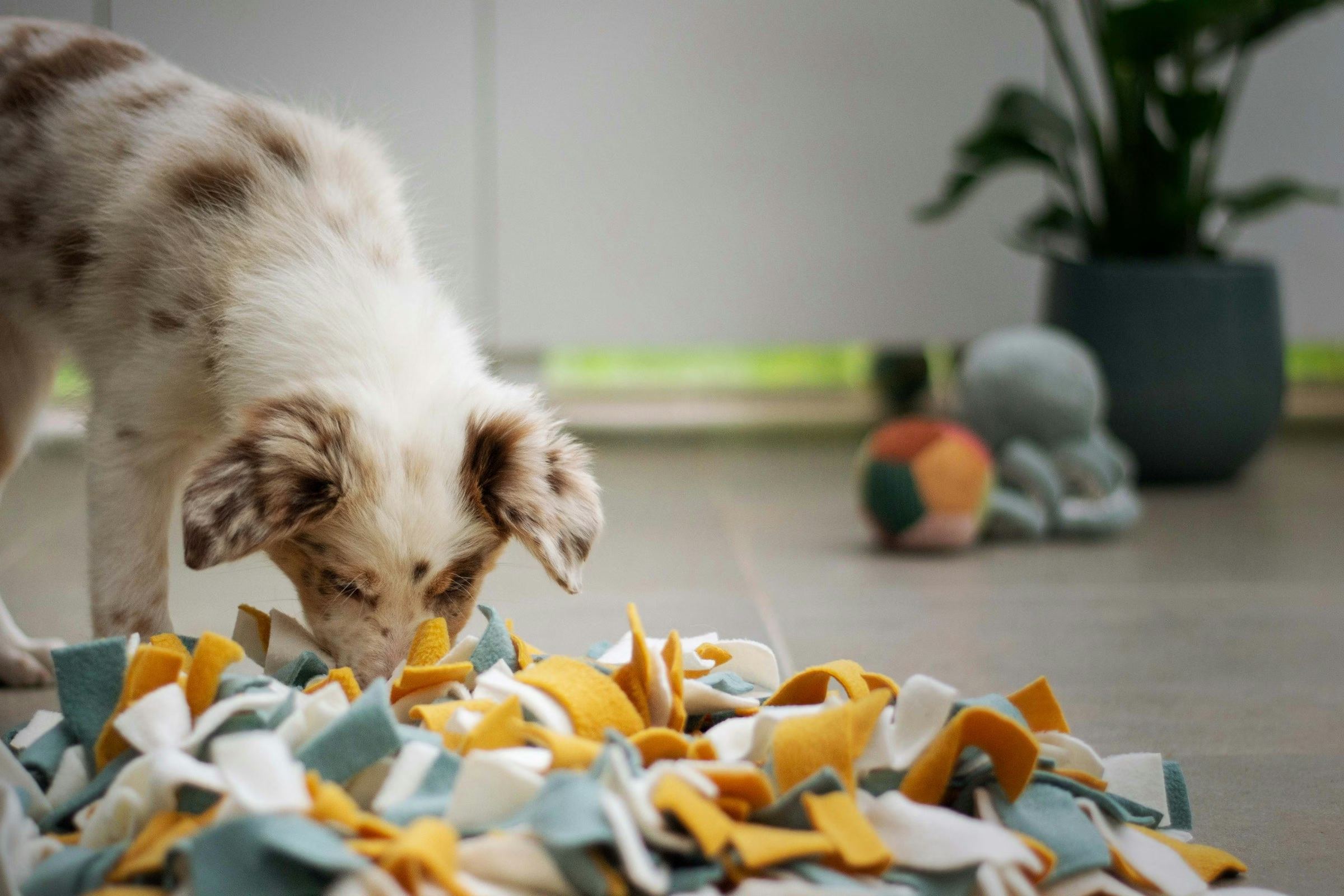
A DIY snuffle mat for dogs is a simple homemade activity that turns mealtime or treat time into a sniffing game. It uses strips of soft fabric attached to a base, creating small spaces where you can hide dry treats or kibble for your dog to discover.
You can make a basic snuffle mat at home using a rubber sink mat with holes, fleece fabric and a pair of scissors. Cut the fabric into strips, tie them securely through the holes and spread the strips across the base until most of its surface is covered.
This activity gives dogs an opportunity to use their noses, explore different hiding places and enjoy a more engaging indoor routine. The finished mat should be checked regularly to ensure that the fabric and base remain secure.
What Is a DIY Snuffle Mat for Dogs?

A snuffle mat is a fabric-based activity mat designed to hide small pieces of dry food or treats between soft fabric strips.
Dogs use their noses to search through the material and find the hidden pieces. Instead of eating everything from an ordinary bowl, they explore the mat and discover food at different points.
A homemade snuffle mat follows the same basic idea but allows you to choose its size, fabric colors and overall design.
It can be used as:
- An indoor sniffing activity.
- A playful way to serve some dry kibble.
- A simple addition to a dog’s daily enrichment routine.
- A food-search game for dogs who enjoy exploring with their noses.
Materials Needed to Make a Homemade Dog Snuffle Mat

Before starting, collect the materials and prepare a clean workspace.
| Material | Purpose |
| Rubber sink mat with holes | Provides the base |
| Soft fleece fabric | Creates hiding spaces |
| Scissors | Cuts fabric strips |
| Measuring tape | Helps measure fabric and mat |
| Dry dog kibble or small treats | Used for the sniffing activity |
Choosing the Right Materials
Rubber base: Choose a flat, flexible mat with evenly spaced holes. The holes should be suitable for tying fabric securely without leaving large openings.
Fleece fabric: Soft fleece is commonly used because it is flexible and easy to cut into strips. Choose fabric that does not easily fray or shed loose threads.
Scissors: Use sharp scissors to cut clean strips and avoid uneven fabric edges.
Avoid materials with loose decorative pieces, small detachable parts or sharp components that could create problems during play.
Step-by-Step: How to Make a DIY Snuffle Mat for Your Dog

Follow these steps to create a simple snuffle mat using household craft materials.
Step 1: Prepare the Rubber Base
Place the rubber sink mat on a flat surface and check that it is clean and dry.
If the mat is larger than the space you want to use, measure and trim it carefully, provided its material can be cut safely.
Step 2: Cut the Fleece Fabric Into Strips
Measure the fleece fabric and cut it into strips approximately:
- Width: 1 inch (2.5 cm).
- Length: 7–9 inches (18–23 cm).
These measurements are a practical starting point, not a fixed requirement. You can adjust the length according to the thickness of the fabric and the size of the holes in your base.
Try to keep the strips reasonably consistent so the finished mat has an even appearance.
Step 3: Attach the Fabric Strips
Take one fleece strip and push it through two nearby holes in the rubber base.
Bring both ends together and tie them into a secure double knot.
Repeat this process with additional strips, working across the base one section at a time.
Check that:
- Each strip is securely attached.
- Knots do not easily loosen when gently pulled.
- No long loose fabric ends are hanging unnecessarily.
- The rubber base is not becoming damaged around the holes.
Step 4: Cover the Base With Fabric
Continue attaching strips until the base has a thick layer of fleece.
For a fuller appearance, place the strips close together and distribute them across the entire surface.
Avoid leaving large empty sections where treats could simply fall through the holes.
You can use two or three fleece colors to create a simple pattern. However, the main purpose is to create enough fabric folds for hiding small pieces of dry food.
Step 5: Check the Finished Snuffle Mat
Before introducing the mat to your dog, inspect the entire project.
Gently pull individual strips to check their knots. Look for loose threads, damaged holes, exposed sharp edges or pieces that could detach.
Also check that the base does not slide excessively across the floor. A stable mat is easier for dogs to explore.
Do not use the mat if any part is loose or damaged.
Step 6: Introduce the Snuffle Mat to Your Dog
Follow these steps:
- Place the mat on a clean, flat floor.
- Let your dog approach and investigate it.
- Place a few pieces of familiar dry kibble on top of the fleece.
- Allow your dog to sniff and discover the food.
- Once your dog understands the activity, hide a few pieces between the fabric strips.
Stay nearby and observe how your dog interacts with the mat.
If your dog tries to chew, pull out or swallow the fabric, stop the activity and remove the mat.
Tips for Making Snuffle Mat Time More Enjoyable
A homemade snuffle mat does not need complicated features to provide an interesting activity. A few simple adjustments can make it easier to use.
Start With Easy Food Hiding Spots
For the first few sessions, leave some kibble visible on top of the fleece. This helps your dog understand that the mat contains food.
As your dog becomes familiar with the activity, place small amounts between the fabric folds.
Use Familiar Dry Food
You can use a portion of your dog’s usual dry kibble instead of introducing unfamiliar treats.
This also makes the activity easy to include in an existing feeding routine. Remember to account for the food used on the mat as part of your dog’s normal daily food allowance.
Keep the Activity Short and Simple
Allow your dog to explore at a comfortable pace. There is no need to fill every section with food or make the activity increasingly difficult.
The purpose is to provide an enjoyable sniffing opportunity, not to create frustration.
Choose a Suitable Location
Place the snuffle mat somewhere with enough space for your dog to move around comfortably.
Avoid placing it near doorways, busy walking areas or places where other pets might interrupt the activity.
How to Clean and Maintain a DIY Snuffle Mat
Regular maintenance helps keep a homemade snuffle mat in good condition.
- Remove leftover kibble and crumbs after every session.
- Shake out loose dirt and fabric particles.
- Inspect knots and fabric strips before each use.
- Check the rubber base for cracks or damaged holes.
- Wash the fabric according to its care instructions.
- Allow all parts to dry completely before using the mat again.
If the rubber base and fleece fabric have different cleaning requirements, follow their individual care instructions.
Replace the mat when the fabric becomes heavily damaged, knots repeatedly loosen or the base develops cracks.
Frequently Asked Questions (FAQs)
1. Can I make a snuffle mat without a sewing machine?
Yes. A sewing machine is not necessary for a basic DIY snuffle mat. You can attach fleece strips to a rubber base by tying them through its holes. This makes the project relatively simple for beginners.
2. What fabric is suitable for a homemade dog snuffle mat?
Fleece is a commonly used option because it is soft, flexible and easy to cut into strips. Choose a fabric that does not easily fray or release loose fibres.
3. How many fabric strips do I need?
The number depends on the size of your rubber base, the spacing between holes and how full you want the mat to look. The important thing is to distribute the strips evenly and secure each one properly.
4. Can I use my dog’s regular kibble in a snuffle mat?
Yes. A portion of your dog’s usual dry kibble can be used for this activity. It provides a familiar food option without requiring separate treats.
5. How often can I use a DIY snuffle mat?
You can include it in your dog’s regular indoor activity routine when appropriate. The frequency and duration depend on your dog’s interest and how safely they interact with the mat. Always supervise its use.
6. Are there any disadvantages to using a DIY snuffle mat?
Yes. Homemade mats require regular inspection and cleaning. Fabric strips can become loose, and dogs that chew or swallow fabric may not be suitable users.
The activity also requires supervision, particularly during the first few sessions.
7. Can puppies use a snuffle mat?
Puppies may explore a snuffle mat as a supervised activity, provided the materials and construction are suitable for their size and behavior. Introduce it gradually and remove it if the puppy starts chewing or pulling out the fabric.
8. How do I know when a snuffle mat needs replacing?
Replace it if you notice loose knots, torn fleece, damaged rubber, sharp edges or pieces that can detach easily. A damaged mat should not be used until it has been repaired safely or replaced.
9. Can I make a snuffle mat using different fabric colors?
Yes. You can combine different fleece colors to create patterns or sections. Just make sure all fabrics are suitable, securely attached and free from detachable decorations.