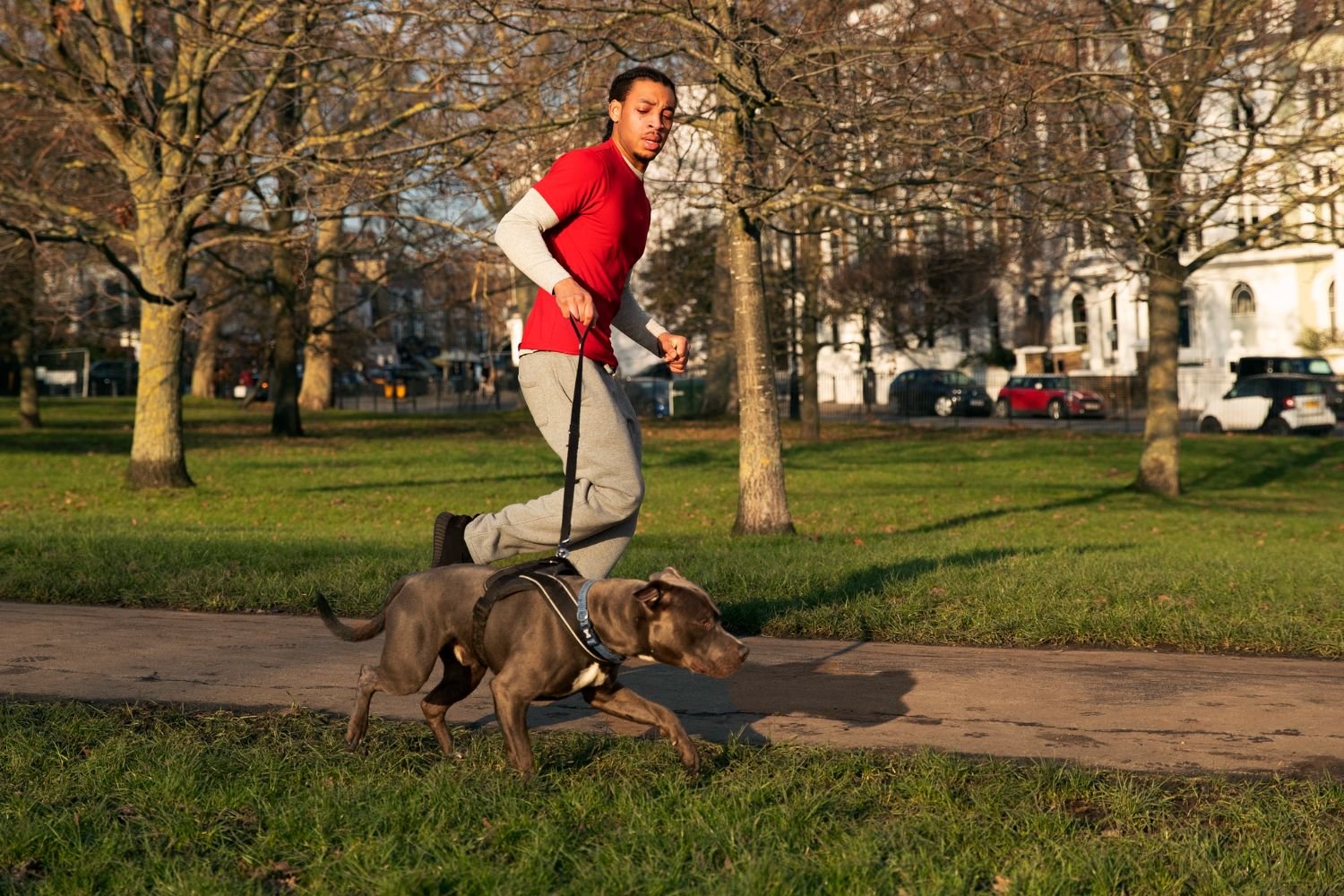

There’s a particular kind of exhaustion that comes from walking a dog who treats the leash like a tug-of-war rope. Your shoulder aches, your dog’s coughing from the collar strain, and the walk that’s supposed to be relaxing ends up feeling like a workout you didn’t sign up for. The good news: learning how to stop your dog from leash pulling doesn’t require choke chains, prong collars, or anything that relies on discomfort to get results. Force-free methods work — they just ask for more patience and consistency than a quick fix would.
Leash pulling is a common training challenge for dog owners, and it makes sense why. Dogs naturally walk faster than we do, and nobody explicitly teaches a puppy that a loose leash is the goal. The techniques below build that understanding gradually, without ever needing to use pain or fear to get there.
Why Dogs Pull in the First Place
Pulling isn’t stubbornness or dominance — it’s usually just simple reinforcement at work. A dog may learn that pulling helps them reach something they want, such as moving toward a smell, another dog, or an interesting area. When pulling repeatedly succeeds in getting access to those things, the behavior can become more persistent over time.
That can make the training principle easier to understand: reduce the opportunities for pulling to achieve the desired outcome, and consistently reward the loose-leash behavior you want instead.
Choosing Equipment for Loose-Leash Training
Skip Aversive Tools
Force-free training avoids aversive tools such as choke chains, prong collars, and shock collars, which rely on physical or psychological discomfort to suppress unwanted behavior. These tools can suppress the behavior temporarily, but they don’t teach a dog what to do instead, and they carry real risk of physical injury and increased anxiety around walks.
Consider a Properly Fitted Front-Clip Harness
Front-clip harnesses can redirect a dog’s movement when they pull, which may make forward pulling less effective while avoiding direct pressure from the leash on the neck. The fit and design of the harness still matter, and no walking device is ideal for every dog. A 2024 peer-reviewed study of 23 dogs found that dogs produced lower pulling impulse on a front-connection harness than on a martingale collar during the study’s controlled walks. However, the researchers cautioned that the results should not be generalized to all dogs or everyday walking situations. A properly fitted front-connection harness can therefore be one useful management option, but it works best alongside training rather than replacing it. Combined with the techniques below, it can make managing pulling easier while you work on the underlying behavior.
The Core Force-Free Techniques
The Stop-and-Go Method
When the leash becomes tight, stop walking and remain still. The instant your dog turns back toward you or the leash goes slack, resume walking immediately as the reward. This teaches, through repetition, that pulling stops forward progress, while a loose leash is what keeps the walk moving.
The “Be a Tree” Approach
Similar to stop-and-go but useful for dogs who pull hard and consistently: when the leash tightens, plant your feet and become completely still and unresponsive, like a tree, until your dog offers slack on their own. No pulling back, no yanking, just a calm, immovable pause.
Direction Changes
Rather than always stopping, occasionally just turn and walk the opposite direction the moment your dog starts pulling ahead. This keeps your dog checking in with you throughout the walk instead of tuning you out and charging forward on autopilot.
Reward Position, Not Just Behavior
Rewarding the position you want helps your dog learn what successful loose-leash walking looks like, rather than focusing only on stopping unwanted pulling.
- Mark and reward your dog whenever they’re walking near your side without being asked
- Use a clicker or a simple verbal marker, followed immediately by a treat, so the timing is precise
- Reward frequently in the beginning, then gradually stretch out the intervals as the habit builds
- Practice in low-distraction environments first before testing the skill somewhere busier
Engage-Disengage Games
For dogs who pull specifically toward distractions like other dogs or squirrels, reward your dog the moment they notice the distraction and then look back at you on their own. Over time, this builds a habit of checking in with you rather than fixating and pulling toward whatever caught their attention.
Building a Consistent Practice Routine
Short, frequent sessions genuinely beat one long walk where you’re trying to fix everything at once. Five or ten focused minutes of loose-leash practice in the yard or a quiet street can be easier for many dogs to handle than trying to teach the skill throughout an entire, highly distracting walk. Short, regular practice also gives you more opportunities to reinforce the behavior you want.
The American Veterinary Society of Animal Behavior (AVSAB) recommends reward-based methods for dog training and behavior modification and advises against aversive techniques such as leash jerking, prong collars, choke chains, and electronic shock collars.
Benefits and Drawbacks of Force-Free Leash Training
Benefits
- Builds trust between you and your dog instead of relying on fear or discomfort
- Teaches and reinforces an alternative walking behavior rather than relying on discomfort to suppress pulling
- Reduces physical risk to your dog’s neck and throat compared to aversive tools
- Strengthens your dog’s overall responsiveness and attention during walks
- Works well alongside other force-free training goals you might be teaching at the same time
Drawbacks and How to Manage Them
- It takes longer than aversive methods promise. Set realistic expectations that progress may take repeated practice, and track small wins so gradual improvement is easier to recognize.
- Consistency is genuinely hard, especially with a busy schedule. Short daily sessions are more sustainable than occasional long ones, so build training into an existing routine like a morning coffee or evening wind-down.
- High-distraction environments can undo progress temporarily. Practice in progressively busier locations only once the basics are solid somewhere quiet.
- Other family members may unintentionally reinforce pulling. Get everyone in the household using the same stop-and-go approach, since inconsistent handling slows progress considerably.
Common Mistakes That Slow Down Progress
Yanking the leash back the moment a dog pulls is one of the most common accidental habits, and it actually works against force-free training by adding an aversive element back into the mix. Giving up on stop-and-go too early, before the dog has had enough repetitions to connect the pattern, is another frequent issue — this method may require many repetitions before your dog consistently understands the pattern. Practicing exclusively during real walks, rather than dedicating separate short training sessions, also slows things down, since real walks come loaded with distractions that make learning harder from the start.
Conclusion
Learning how to stop your dog from leash pulling without force comes down to consistency more than any single technique. Stop-and-go, direction changes, and rewarding a loose leash all help teach the same underlying lesson: pulling does not reliably move the walk forward, while walking calmly with you leads to continued progress. It takes real patience, but the payoff is a dog who walks with you instead of against you, built on trust rather than discomfort.
Frequently Asked Questions
How long does force-free leash training typically take?
The timeline varies from dog to dog. Some dogs may show early improvement after repeated practice, while others need considerably longer, especially when pulling is strongly reinforced or distractions are difficult. Focus on gradual progress and increasing the level of distraction only when your dog can succeed at the current level.
Is a front-clip harness enough on its own to stop pulling?
Not entirely. A front-clip harness can make pulling easier to manage, but it does not replace training. Pairing appropriate equipment with loose-leash training helps teach the walking behavior you actually want.
My dog only pulls toward other dogs. Do these methods still work?
It can be useful when your dog pulls toward specific distractions, because it gives you a way to reinforce noticing the distraction and then checking back in with you. Start at a distance where your dog can still respond and gradually work closer as they improve.
Should I ever use treats for leash training, or does that create dependence?
Frequent treats early on help build the habit fast, and you can gradually fade them out over time as loose-leash walking becomes the default rather than something that needs constant reinforcement.
Can older dogs with years of pulling habits still learn to walk on a loose leash?
Yes. Older dogs can learn new walking behaviors, although the pace of progress varies between individuals. Dogs with a long-established pulling habit may need consistent practice and careful management of distractions while the new behavior develops.